

Briefly Explained – What Is Digital Time Tracking in Medical Practices?
Digital time tracking refers to the electronic recording of the start, end, and duration of daily working hours – replacing paper lists, timesheets, or Excel spreadsheets.
For medical practices, this topic is relevant for two reasons: case law already requires employers in 2026 to implement systematic working time documentation, and electronic time tracking will definitely become legally mandated in the foreseeable future.
Nevertheless, time tracking and shift planning are two distinct processes. The shift schedule determines in advance who is scheduled when. Time tracking documents what was actually worked – including deviations, overtime, and breaks.
Workforce planning software like Planerio optionally combines both functions in one interface, thereby reducing administrative effort.
Is Time Tracking Legally Mandatory in Medical Practices?
- ECJ Judgment C-55/18 of May 14, 2019
The European Court of Justice ruled for all EU member states to require employers to establish a system for recording daily working time. The judgment applies across all sectors – including medical and dental practices. - BAG Decision 1 ABR 22/21 of September 2022
The Federal Labor Court determined that the obligation for daily and complete working time tracking already applies in Germany based on § 3 of the Occupational Safety and Health Act. Practice owners therefore do not need to wait for new legislation. - Coalition Agreement CDU/CSU and SPD 2025 – Outlook 2026
In the 2025 coalition agreement, the governing parties agreed to introduce a mandatory electronic time tracking requirement. Corresponding legislation is still pending; transitional periods – particularly for smaller businesses – are planned but not yet finalized. For medical practices, this means: the substantive obligation to record exists today, and the electronic form will become binding shortly.
What specifically applies now:
- The start, end, and duration of daily working time must be recorded.
- Overtime and working hours on Sundays and public holidays are subject to documentation requirements under § 16 para. 2 ArbZG.
- Violations of the overtime documentation requirement are already subject to fines today.
- Violations of the general daily recording obligation are currently not directly punishable, but can result in significant disadvantages for the employer in labor disputes.
What working time data must be recorded in medical practices?
Practical requirements: The following information must be documented for each employee – Medical Assistants as well as physicians.
- Start and end of daily working time
- Total duration of hours worked
- Break times – timing and duration
- Overtime – hours worked beyond agreed working time
- Work on Sundays and public holidays
Retention
According to § 16 para. 2 ArbZG, records must be retained for at least two years. From a tax perspective – for example during tax audits – retention of up to ten years is recommended. By the way: digital systems automatically archive this data from day one, without any additional effort.
Privacy Policy
Working hours are personal data within the meaning of GDPR. Recording requires clear access rights, secure storage, and transparent information obligations toward employees. A data processing agreement is mandatory for cloud-based solutions.
Exceptions
Senior executives with genuine discretion over their working time currently do not need to document their working hours. However, the recording obligation applies without restriction to Medical Assistants and the majority of practice staff.
Special Considerations for Medical Assistants – What the Collective Agreement Requires for Working Hours and Documentation
Medical Assistants are subject not only to the Working Hours Act but also to the collective framework agreement for Medical Assistants (TV-MFA), which sets specific working time requirements. Practices must take these collective agreement provisions into account when tracking time.
Collective Agreement for Medical Assistants – Key Provisions at a Glance
- Standard working hours: 38.5 hours per week for full-time employment
- Overtime: Must be expressly ordered or approved. From the first overtime hour, entitlement to shift allowance or time off in lieu applies.
- Overtime compensation: The collectively agreed allowance regulations can only be correctly calculated if hours worked are documented without gaps.
- Documentation obligation: Practice owners are required to provide proof to Medical Assistants – for both overtime worked and compensated.
Recording break times correctly
§ 4 ArbZG prescribes the following minimum breaks:
- 30 minutes for working time between 6 and 9 hours
- 45 minutes for working time over 9 hours
In the hectic practice environment, employees often find it difficult to manually record breaks correctly – because they arise unplanned, are interrupted, or are forgotten during ongoing operations. Digital solutions automatically suggest break times or log them anyway. This makes documentation significantly more reliable and relieves staff.
Digital vs. Analog Time Tracking – A Comparison for Practices
| Criterion | Analog / Excel | Digital |
|---|---|---|
| Legal Compliance | Limited – incomplete and vulnerable | High – audit-proof storage |
| Effort | High – manual maintenance, error-prone | Low – largely automated |
| Reporting Capability | Hardly available | Real-time reports, direct export |
| GDPR Compliance | Difficult to ensure | Can be implemented at system level |
| Payroll Accounting | Manual transfer required | Export function directly integrable |
| Future-Proofing | Not prepared for electronic obligation | Meets future legal requirements |
When selecting a digital time tracking tool, the following points are relevant:
- Industry suitability: Does the system recognize TV-MFA, shift models, on-call services, on-call duties, emergency medical services, preparation time, and substitute arrangements?
- Recording methods: Are various input forms possible – app, PC, terminal?
- GDPR: Where are the servers located? Is there a data processing agreement?
- Integration: Are seamless connections to payroll or practice software possible?
Planerio – Digital Time Tracking for Healthcare Facilities
Planerio is software for digital shift planning and time tracking developed specifically for healthcare facilities – from medical practices and MVZs to hospitals with multiple sites.
Today, over 4,000 sites from various industries use our AI-assisted solution for shift planning and time tracking.
How Planerio Implements Time Tracking in Medical Practices
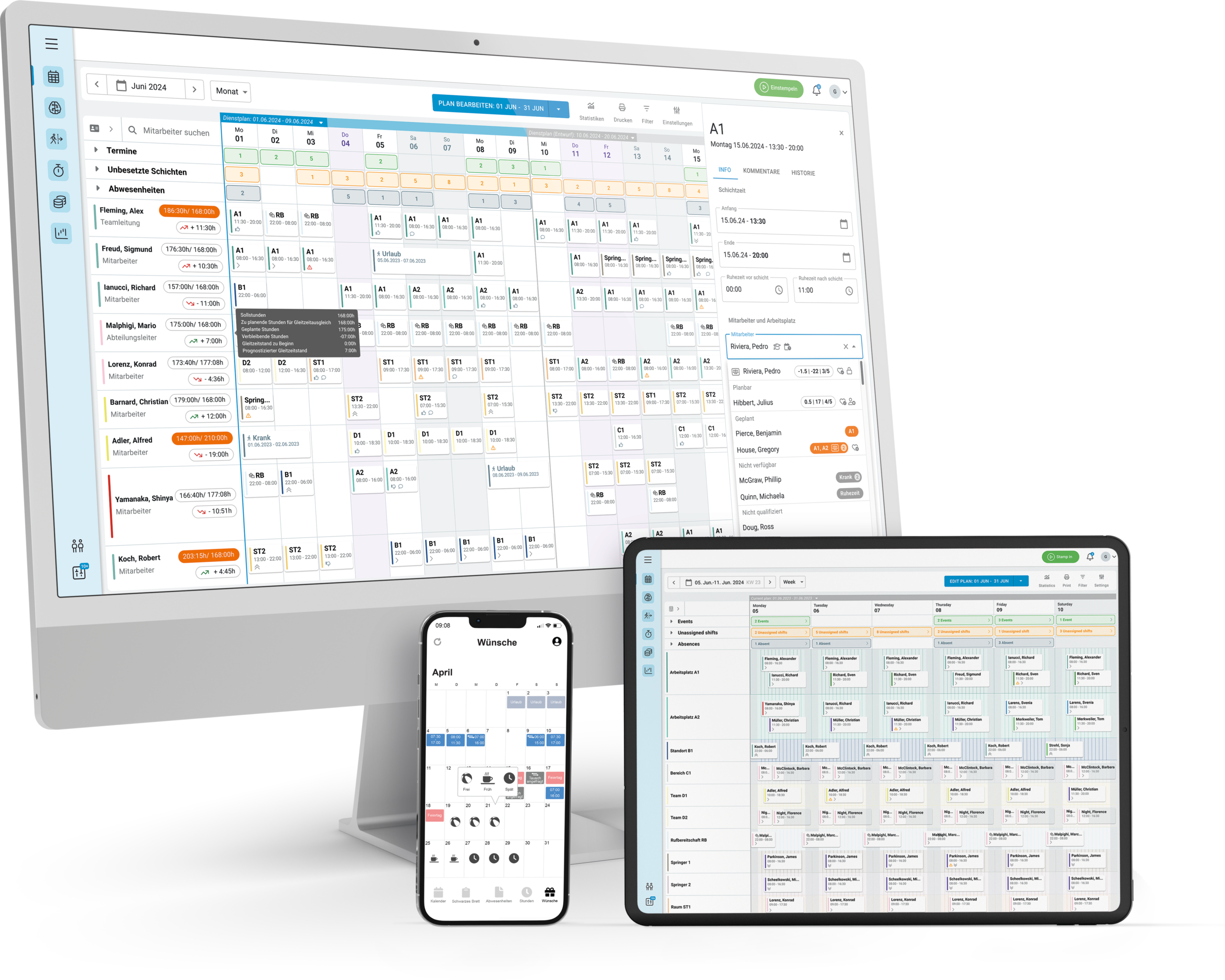
Employees can record working time in various ways – depending on what suits the practice structure:
- Via app on smartphone
- Via PC in browser
- Via terminal with RFID chip – for practical clocking in and out
Planerio automatically calculates overtime, breaks, preparation time, and absences and stores all entries in an audit-proof manner. Monthly analytics can be exported directly – compatible with common payroll systems. Data storage is GDPR-compliant with servers located in Germany.
An initial overview is provided by the interactive product demo for time tracking.
FAQ – Frequently Asked Questions About Time Tracking in Medical Practices
The obligation to track working time applies in Germany based on the 2019 ECJ judgment and the 2022 BAG decision. The electronic form will accordingly become binding with the planned Working Hours Act based on the 2025 coalition agreement. Practices that switch to a digital system now are legally on the safe side and will not have to act under time pressure later.
Suitable time tracking tools directly reflect the specific requirements of medical practices: for example, shift operations, TV-MFA, preparation time, on-call duties, emergency services, changing staffing and qualifications of Medical Assistants and physicians, GDPR requirements, and the option for payroll integration.
Generic HR tools often do not fully cover these requirements. Planerio was developed for healthcare facilities and combines time tracking and optionally shift planning in one system – with legally and collectively compliant recording via app, PC, or RFID terminal.
According to § 16 para. 2 ArbZG, at least two years, but retention of up to ten years is recommended for tax reasons. Digital systems automatically archive the data in a structured manner.
Failure to document overtime and Sunday/public holiday work already results in fines under current ArbZG. Furthermore, in labor disputes – such as claims for overtime compensation – the employer bears the burden of proof. Without records, this defense is hardly possible.
Conclusion
In short: the obligation to track working time already applies to medical practices today – and the requirements will be further specified with the planned legislation on electronic time tracking. Practices that act now avoid legal risks, create transparency for the practice team, and are prepared for upcoming requirements.
Legal Notice – Legal status: July 2026
This article does not replace legal advice; the legal situation may have changed since then. For your specific case, consult your legal department or a law firm specializing in labor law.