Table of Contents
Key Figures
Customer Description
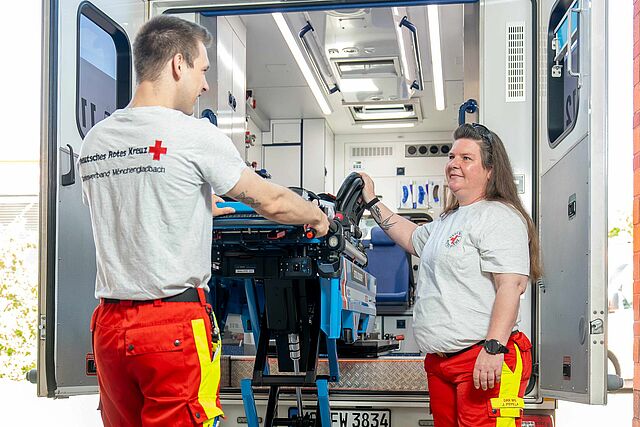
The DRK district association Mönchengladbach has around 170 employees. In crisis situations, there were nearly 200, for example during the refugee crisis in 2016 and during the COVID-19 period. Around 70 work in the ambulance service, and they plan their trips and missions with nine different vehicles using Planerio. In addition, there are three to four people from the administrative office, where Planerio is only used for working time documentation. The ambulance service operates nine vehicles: four rescue vehicles, four ambulances, and one special vehicle, each staffed by two people.
The district association also includes a health center with an outpatient care service, palliative care, dementia care, emergency home call system, and housekeeping services.
Profile
- Setting up the interface
- DRK District Association Mönchengladbach e. V.
- Sector / Application Area
- Security & Rescue, ambulance service
- Region
- Mönchengladbach, North Rhine-Westphalia
- Employees in the plan
- around 70 in the ambulance service, plus 3 to 4 from the administrative office
- shift groups
- 9 vehicles, shift lengths of 8, 12, 16, and 24 hours, 2 people each
- Planerio customer since
- June 2022
- Previously in use
- Excel for shift planning and time tracking, times on paper at the end of the month
- Modules used
- digital shift planning, time tracking & time and attendance, payroll preparation, employee scheduling app
- Integrations
- Export of payroll data to DATEV LODAS
- Contact person
- Mike Boochs, District Managing Director
- sites
- 3 ambulance stations
- Time to go-live
- 3–4 months
Challenge
One rescue vehicle could be planned in Excel; nine could not.
The district association started the ambulance service with a single rescue vehicle and five employees. An Excel spreadsheet was sufficient for this. Calculating the shift allowances once a month was tedious but manageable. Employees submitted their times on slips of paper at the end of the month, and someone typed them into the spreadsheet.
With nine vehicles, this was no longer possible. There is no fixed grid like a three-shift plan in the ambulance service. One vehicle runs on a 24-hour shift, others on 8, 12, or 16-hour shifts. Therefore, shift planning software must first be individually configurable for this operation.
Then there is the staffing. There are two people in each vehicle, and both need specific qualifications: at least one of them needs a driver’s license, plus a qualification as an EMT, paramedic, or emergency paramedic depending on the vehicle type. Emergency paramedics are allowed to work 24-hour shifts, work a 48-hour week, and have a higher opt-out, meaning they can be scheduled beyond that. Neither applies to 40-hour staff.
Each shift length entails its own rules: different rest times and days off, different shift allowances, and for 24-hour shifts, the break is credited to the flexitime account because the crew remains at the station and the break often only lasts a few minutes.
The monthly closing was the second bottleneck. Two hours were spent calculating the shift allowances for five employees from the slips of paper. Extrapolated to 70 employees, that would be approximately 22 hours! This was followed by several rounds to find transcription errors. And if an audit asked for the working time accounts, someone had to gather the numbers first.
“At some point, it was no longer possible because the overview was missing. You have errors in there that you don’t even see because there is too much data.”

Solution
Planerio was the only tool considered as a solution for the DRK District Association Mönchengladbach. So there was no lengthy selection process; the district association did not look at any other systems. After the first conversation with the Planerio team, the decision for the software was made. The idea of having the complex shift planning created by the Planerio algorithm in the future instead of by hand was convincing, and the offer was also a good fit financially. Additionally, Mönchengladbach would have been the first ambulance service in the Planerio customer base. Mike Boochs says of himself that he likes to test things.
Because the ambulance service with its special rules was new to Planerio, the company assigned a particularly experienced onboarder to the project. The customer himself also made the difference. Mike Boochs familiarized himself with Planerio from the start, exploring the possibilities offered by AI shift planning, which allowed for a lot of joint development.
“I was taken with the idea of AI after the first conversation with Planerio.”
Mike Boochs, District Managing Director, DRK District Association Mönchengladbach
What shift planning software in the ambulance service must deliver
Planning runs against stored rules. Vehicle requirements, shift length, qualification, and rest time are interdependent, and where something clashes, Planerio shows the conflict directly in the plan instead of only at the end of the month in the billing. As a result, shift plans are created significantly faster and with fewer errors than in the Excel era, says Mike Boochs.
In the district association’s account, more than just the shift length depends on this:
- Qualifications per vehicle type, stored individually for both positions: driver’s license plus the appropriate rescue qualification
- Different shift models per vehicle, from 8 to 24 hours
- Weekly working hours of 40 and 48 hours, plus the higher opt-out for emergency paramedics
- rest times and days off that depend on the length of the preceding shift
- shift allowances and wage types per shift type, including the break rule for 24-hour shifts
Monthly closing takes three hours instead of 22
Planerio calculates the shift allowances from the recorded times. No one has to reconstruct them from slips of paper anymore. The prepared payroll data is then sent to the external tax office, which works with DATEV LODAS.
Previously, monthly closing meant: “Calculating two hours for the five employees with shift allowances.” And today: “Three hours for the 70 employees, then I’m done.”
Mike Boochs, District Managing Director, DRK District Association Mönchengladbach


Times are recorded on-site instead of at the end of the month
Employees clock in directly on-site. There are no terminals at the district association; time tracking runs entirely via the employee scheduling app. The crews go directly to their vehicle in the morning, log into the app, and drive off. The detour via the headquarters is eliminated. There is no longer a time lag between the shift and documentation.

If an audit occurs, the monthly overview is usually requested. Working time, wage type, break deduction, remaining annual leave, and sickness days are listed there together, and the administrative office accesses them directly in Planerio instead of gathering numbers. Such audits are triggered externally, usually every one to two years.
Shift and time-off preferences in the app also help with recruitment
In the employee scheduling app, the approximately 70 employees submit leave requests, short-term absences (e.g., due to sickness), and their time-off preferences themselves, and explicitly also shift preferences. The benefits of Planerio were evident even before the first shift. Emergency paramedics are in short supply in the district association, and in job interviews, the opportunity to help shape shifts is an argument that applicants apparently do not know from other employers.
“In job interviews, when we say: You can enter your leave requests in the app, your time-off preferences, but also your shift preferences, the applicants are surprised; they don’t know that from anywhere else.”
Mike Boochs, District Managing Director, DRK District Association Mönchengladbach
What the plan does not (yet) solve automatically
According to Mike Boochs’ assessment, Planerio’s AI planning function covers about 70 percent of the shift plan in Mönchengladbach. For the remaining shifts, colleagues state they spend five to six hours per month fine-tuning the plan. This is due to the special combination of qualifications, driver’s license classes, and shift lengths, which is why the plan could not be fully automated. Adjusting the rules to the point where the automation meets them would take a lot of time, as it sometimes involves nuances. The district association therefore decided not to push the fine-tuning further and to set the last shifts manually.
“I believe that technological progress will take us another step forward in the next two or three years.”
Mike Boochs, District Managing Director, DRK District Association Mönchengladbach
Result
- Payroll preparation (monthly closing) now only takes three hours for around 70 employees thanks to Planerio.
- One vehicle has become nine, and five employees in the plan have become around 70. The planning organization has remained the same.
- Time tracking runs without terminals: around 70 employees clock in via the app or directly at the vehicle.
- Working time accounts can be viewed at any time instead of being reconstructed at the end of the month. Preferences and requests are handled via the employee scheduling app.
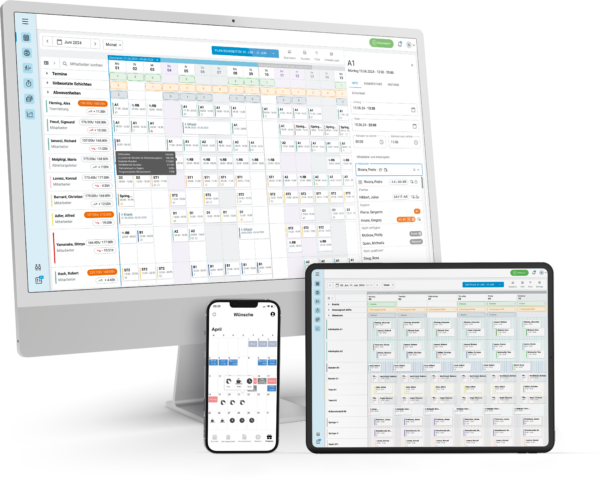
Over 4,000 sites organize their shift planning with Planerio.