
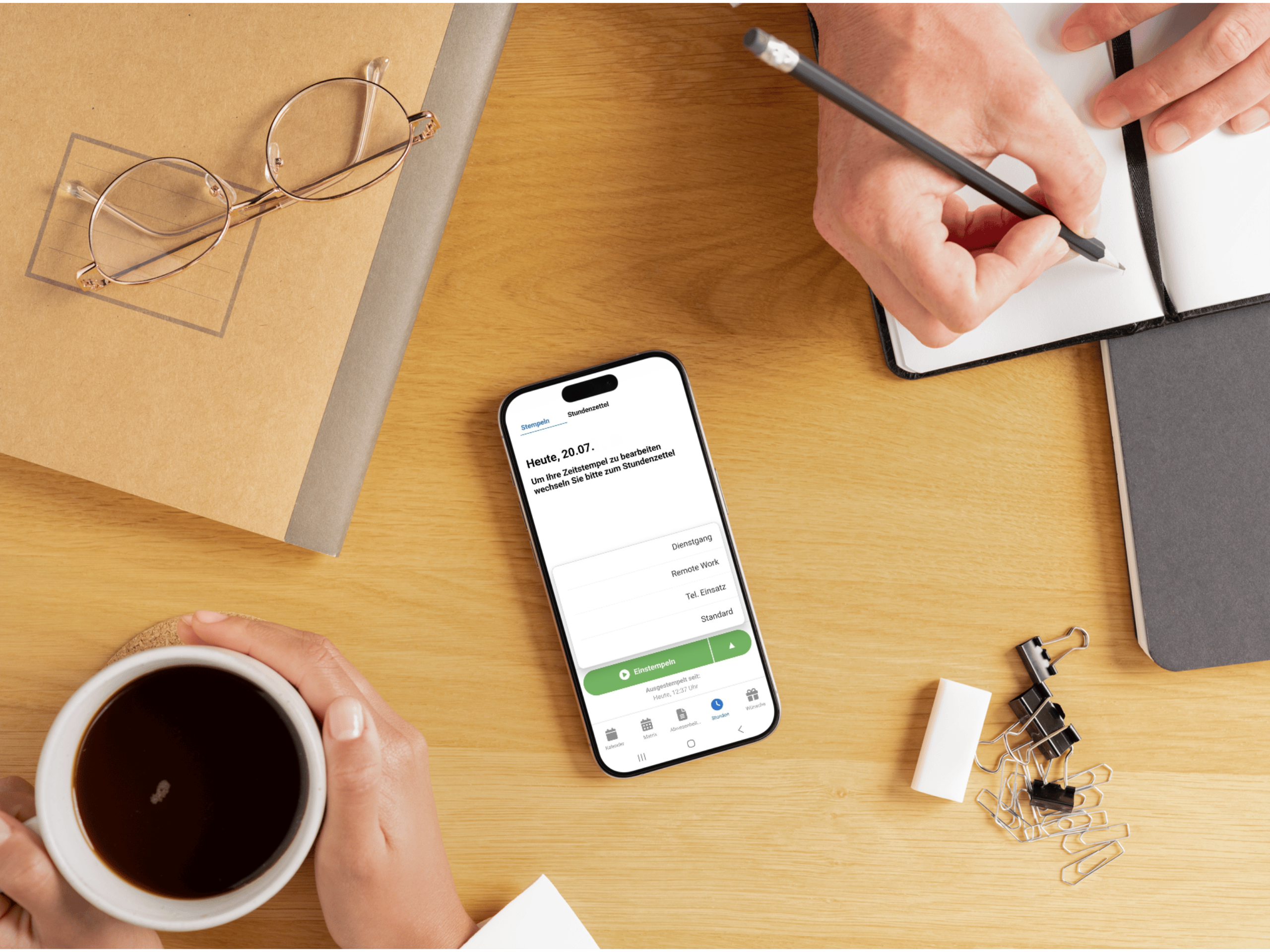
The obligation to track working time has been in effect in Germany since 2019, across all industries. Learn what is legally required, what the 2026 draft bill provides, and how to implement it in a legally compliant manner with Planerio.
Key Takeaways
- The obligation to track working time has been in effect in Germany since 2019, covering all industries and company sizes.
- From 2026, electronic tracking is expected to become the standard, with transition periods varying by company size.
- Key data to be recorded includes start, end, duration of daily working time, breaks, and overtime.
- Planerio offers a digital solution for legally compliant working time tracking that is GDPR-compliant and supports more than 4,000 sites.
- Companies should switch to digital systems now to create transparency and meet legal requirements in time.
Explained: What Does the Obligation to Track Working Time Mean?
The obligation to track working time requires employers to systematically and reliably document the start, end, and duration of their employees’ daily working time. It has been in effect since the ECJ ruling of 2019 and the BAG decision of 2022, regardless of industry or company size. Currently, the form of tracking (paper, Excel, app, terminal) is still flexible, as long as it is objective and verifiable. The draft bill from the Federal Ministry of Labor dated June 2026 provides for making electronic tracking the statutory standard. The substantive obligation exists today; the mandatory electronic form is being specified.
Important for context: time tracking and shift planning are two processes. The shift plan determines in advance who is scheduled when. Time tracking documents what was actually worked, including deviations, overtime, and breaks. A software for time tracking and time and attendance like Planerio connects both levels in one system if desired.
Is Working Time Tracking Legally Mandatory? The Legislative Timeline 2019–2026
The legal situation has evolved through several stages. The key distinction is between the obligation to track (applies today) and the planned electronic form (in the legislative process).
- ECJ Judgment C-55/18 of May 14, 2019. The European Court of Justice required all EU member states to introduce an objective, reliable, and accessible system for recording daily working time. The ruling applies across all industries.
- BAG Decision 1 ABR 22/21 of September 13, 2022. The Federal Labor Court ruled that the obligation to track daily and complete working time already exists in Germany under Section 3 of the Occupational Safety and Health Act (ArbSchG). With the publication of the reasoning on December 3, 2022, it became clear: employers do not need to wait for a new law.
- Failed draft bill (April 2023). The Federal Ministry of Labor at the time presented an initial draft for electronic tracking. It was never introduced into a legislative process.
- Coalition agreement CDU/CSU and SPD (2025). The governing parties agreed to introduce the obligation for electronic time tracking and to design it in an unbureaucratic manner.
- Draft bill of June 17, 2026: The Federal Ministry of Labor presented a new, significantly more detailed draft to amend the Working Time Act. The question shifts from “whether” to track to “how” to track. As of July 2026, the draft has not yet been passed and is not published in the Federal Law Gazette.
The obligation to track working time applies today, derived from the ECJ and BAG. The 2026 draft bill does not change the “whether,” but regulates form, deadlines, and fines. Those who switch now act in an orderly manner rather than later under time pressure.
What Does the 2026 Draft Bill on Working Time Tracking Provide?
The draft links two topics: specifying the tracking obligation and increasing flexibility in working time law. The key points:
- Electronic recording of the start, end, and duration of daily working time, generally on the day of performance (Section 16(2) ArbZG-E).
- Delegation permitted: Tracking may be performed by employees themselves or third parties. Responsibility remains with the employer.
- Trust-based working time remains possible, but only with documentation: violations of working and rest time must be detectable.
- Weekly instead of daily maximum working time, but only for companies with a collective agreement or works agreement (Section 7). The 48-hour limit on average remains in place.
- New fine provisions for violations of recording, information, and retention obligations (Section 22 ArbZG-E).
Transition Periods by Company Size
The draft provides for staggered deadlines from the date the law enters into force:
| Company Size | Deadline for Electronic Tracking |
|---|---|
| Large Businesses | no later than 1 year after entry into force |
| Under 250 employees | 2 years |
| Under 50 employees | 5 years |
| Under 10 employees | permanently exempt (manual tracking remains permissible) |
The difference lies less in the obligation itself than in form and transition period. The basic documentation obligation applies unchanged to all.
What Working Time Data Must Be Recorded?
For each employee, the following information must be documented, regardless of industry:
- Start and end of daily working time
- Total duration of working time performed
- Break times by timing and duration
- Overtime beyond agreed working time
- Work on Sundays and public holidays
Retention
Under Section 16(2) ArbZG, records must be retained for at least two years. For tax reasons, such as during a tax audit, retention for up to ten years is recommended. Digital systems archive this data automatically from day one, without additional effort.
Privacy Policy
Working times are personal data within the meaning of the GDPR. Clear access rights, secure storage, and transparent information for employees are required. For cloud-based solutions like Planerio, a data processing agreement (DPA) under Article 28 GDPR is mandatory.
Exceptions
Senior executives with genuine discretionary authority over their working time are exempt from the recording obligation under Section 18 ArbZG. For the majority of employees, it applies without restriction, including persons under 18 years of age.
Digital vs. Analog Time Tracking
| Criterion | Analog/Excel | Digital |
|---|---|---|
| Legal Compliance | Limited, incomplete, and vulnerable | High, audit-proof storage |
| Effort | High, manual maintenance, error-prone | Low, largely automated |
| Reporting Capability | Hardly available | Real-time reports, direct export |
| GDPR Compliance | Difficult to ensure | Systemically implementable |
| Payroll Accounting | Manual transfer required | Export function directly integrable |
| Future-Proofing | Not prepared for electronic obligation | Meets future requirements |
When selecting a system, what matters is: industry suitability (Does the tool know your collective agreement and shift logic, such as TV-MFA in healthcare or driving and rest times in logistics?), tracking methods (app, PC, terminal), GDPR (server location, DPA), and integration into payroll and industry systems.
Tip: Planerio combines time tracking, shift planning, and payroll preparation in one system and demonstrably saves time and effort—even in small companies.
Working Time Tracking with Planerio: Legally Compliant, Digital, Cross-Industry
Planerio is an AI-assisted software for shift planning and time tracking for industries with complex requirements, including healthcare, logistics, manufacturing, retail, and security and emergency services. More than 4,000 sites plan and track with Planerio today.
Employees track their working time in the way that suits the operation:
- Via app on smartphone
- Via PC in browser
- Via terminal with RFID chip or fingerprint
Planerio automatically calculates overtime, breaks, setup and absence times, and stores all entries in an audit-proof manner. Target, planned, and actual hours and time accounts are transparent at all times, including for employees themselves. Monthly reports can be exported directly and transferred via more than 100 integrations to DATEV, SAP, Personio, Sage, and other payroll systems. Legal and collective agreement requirements, including ArbZG, ECJ, and sector-specific regulations, are automatically considered in real time. Data storage is GDPR-compliant with servers located in Germany.
How planning and time tracking can be combined in a legally compliant manner—also with software support—is shown in our article on shift planning with AI.
Practical tip: The transition periods are not a postponement, but preparation time. Those who implement the switch now in an orderly manner give the team time to adjust and have clean processes before the legislator sets the pace.
Frequently Asked Questions on the Obligation to Track Working Time
Yes. The obligation to record daily working time has been in effect in Germany since the ECJ ruling of 2019 and the BAG decision of 2022. The draft bill of June 2026 specifies the form, but as of July 2026 has not yet been passed.
The mandatory electronic form depends on the completion of the legislative process. The draft provides for staggered transition periods: one year for large companies, up to five years for companies with fewer than 50 employees. Companies with fewer than 10 employees are to remain permanently exempt.
Start, end, and duration of daily working time, breaks, as well as overtime and work on Sundays and public holidays. Tracking must be objective, reliable, and verifiable.
Failure to document overtime and work on Sundays and public holidays already carries fines today. In addition, the employer bears the burden of proof in disputes over overtime. Without records, a defense is hardly possible.
Conclusion
The obligation to track working time applies today, across all industries and company sizes. With the 2026 draft bill, the electronic form becomes the foreseeable standard, supplemented by transition periods and new fine provisions. Companies that switch to a digital system now create transparency for their team and meet upcoming requirements without being under time pressure.
The Obligation to Track Working Time Already Exists.
With an electronic form, you are on the safe side!
With Planerio, you track working time in a legally compliant manner via app, PC, or terminal, automatically comply with ArbZG and industry-specific requirements, and seamlessly transfer data to your payroll. More than 4,000 sites already plan with Planerio today.
Legal Notice – Legal status: 15 October 2026
This article does not replace legal advice; the legal situation may have changed since then. For your individual case, contact your legal department or a law firm specializing in labor law.